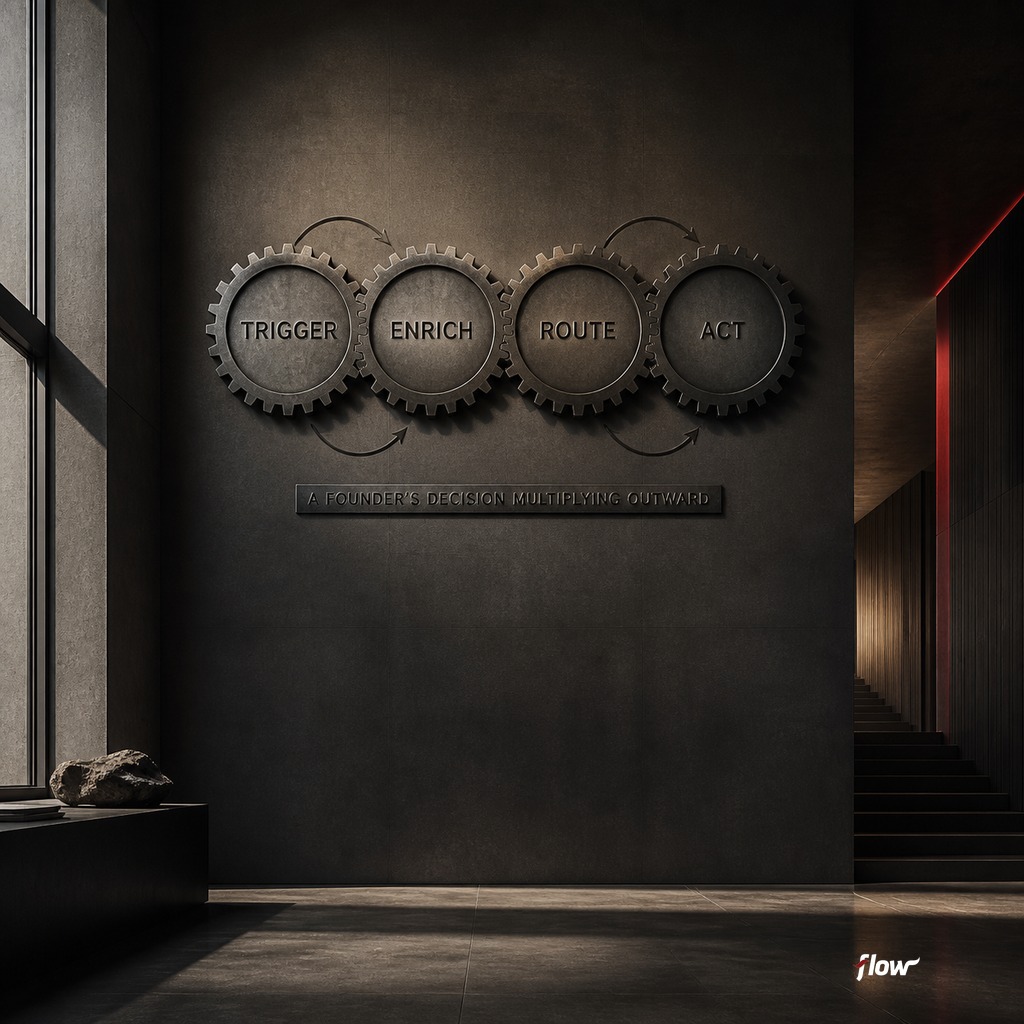
Most B2B founders do not need more automation ideas. They need a pattern they can trust.
That is where Make.com stands out. It works best when you stop thinking in one-off automations and start using a repeatable workflow pattern: trigger, qualify, route, act, and log. This structure keeps automation useful, predictable, and easier to manage as the business grows.
Why this pattern matters
Many teams connect tools and then wonder why the process breaks. The problem is rarely the software. It is the lack of structure.
A good automation pattern does three things:
- captures the right event at the start
- decides what should happen next
- records the result so your team can trust it
When you build this way, you reduce rework and avoid messy handoffs between sales, operations, finance, and customer success.
The five-step Make.com pattern
1. Trigger
Start with a clear event: a form submission, new deal stage, signed contract, or support request. If the trigger is vague, the automation will be vague too.
2. Qualify
Check the data before you move it forward. Confirm required fields, match company records, or filter out low-value requests. This step prevents bad inputs from spreading through your stack.
3. Route
Use conditions to send different records to different paths. For example, enterprise leads can go to a senior rep, while smaller accounts go to a pooled queue.
4. Act
This is where Make.com earns its keep. Create tasks, update CRM fields, send alerts, generate documents, or post to Slack. Keep the action tied to a single business outcome.
5. Log
Write the result somewhere visible. A spreadsheet, database, or CRM note may be enough. Logging helps leaders audit the process and spot failure points fast.
Where founders get value fastest
- Lead routing: get inquiries to the right rep without delay
- Deal desk support: pull pricing, approvals, and contract data into one flow
- Client onboarding: reduce manual setup after a sale closes
- Revenue operations: keep systems aligned across marketing, sales, and finance
Keep it simple
The best automation is not the most complex one. It is the one your team can understand, monitor, and fix without outside help.
If a workflow cannot be explained in five steps, it is probably too fragile for a growing B2B company.
Founders who use this pattern well create leverage without creating chaos. That is the real win.
Muitas empresas começam automando tarefas isoladas. Enviam um lead para o CRM aqui, um alerta no Slack ali, uma planilha atualizada acolá. Funciona por um tempo, mas logo vira um conjunto de integrações frágeis e difíceis de manter.
O padrão mais importante no Make.com resolve esse problema: capturar um evento, enriquecer os dados, decidir o próximo passo e registrar tudo no sistema certo. Parece simples, e é justamente por isso que funciona em operações B2B.
O que esse padrão faz na prática
Em vez de pensar em “ferramentas conectadas”, pense em fluxo de negócio. Um lead entra, o sistema valida informações, busca dados adicionais, classifica o perfil e aciona a próxima ação. O Make.com orquestra essa sequência com clareza.
Exemplo real em vendas
Um formulário de contato gera um novo lead. Antes de entregar para o time comercial, o fluxo pode:
- identificar empresa e domínio;
- consultar tamanho e segmento;
- enriquecer com dados públicos;
- atribuir score;
- direcionar para o vendedor certo;
- registrar o histórico no CRM.
Isso reduz retrabalho e melhora a qualidade da resposta. O vendedor recebe contexto, não apenas um nome e um e-mail.
Por que esse padrão importa para fundadores
Executivos de PMEs B2B geralmente sentem o custo da operação manual antes de perceber o problema técnico. O time perde tempo copiando dados, revisando planilhas e corrigindo inconsistências. O erro não está só na execução. Está no desenho do processo.
Quando você estrutura automações por evento e decisão, ganha três coisas:
- Velocidade, porque o processo reage em minutos, não em horas.
- Consistência, porque todos seguem a mesma regra.
- Rastreabilidade, porque cada etapa deixa registro.
Como evitar automações frágeis
O erro mais comum é criar fluxos longos demais. Quanto mais passos em uma única automação, maior o risco de falha silenciosa. Divida o processo em partes com lógica clara.
Boa prática: use um fluxo para capturar, outro para enriquecer e outro para executar a ação final. Assim, fica mais fácil testar, corrigir e escalar.
Automação boa não é a que faz mais coisas. É a que mantém o negócio funcionando com menos atrito.
Onde esse padrão gera mais valor
Esse modelo funciona bem em áreas com alto volume e muita repetição:
- prospecção e qualificação de leads;
- onboarding de clientes;
- atualização de CRM;
- cobrança e faturamento;
- suporte e triagem de solicitações.
O ponto central não é automatizar tudo. É escolher momentos onde erro manual custa caro e onde a decisão segue regras claras.
Conclusão
O padrão mais valioso no Make.com é simples: evento, enriquecimento, decisão e registro. Fundadores que entendem isso deixam de tratar automação como truque operacional e passam a usá-la como parte da arquitetura do negócio.