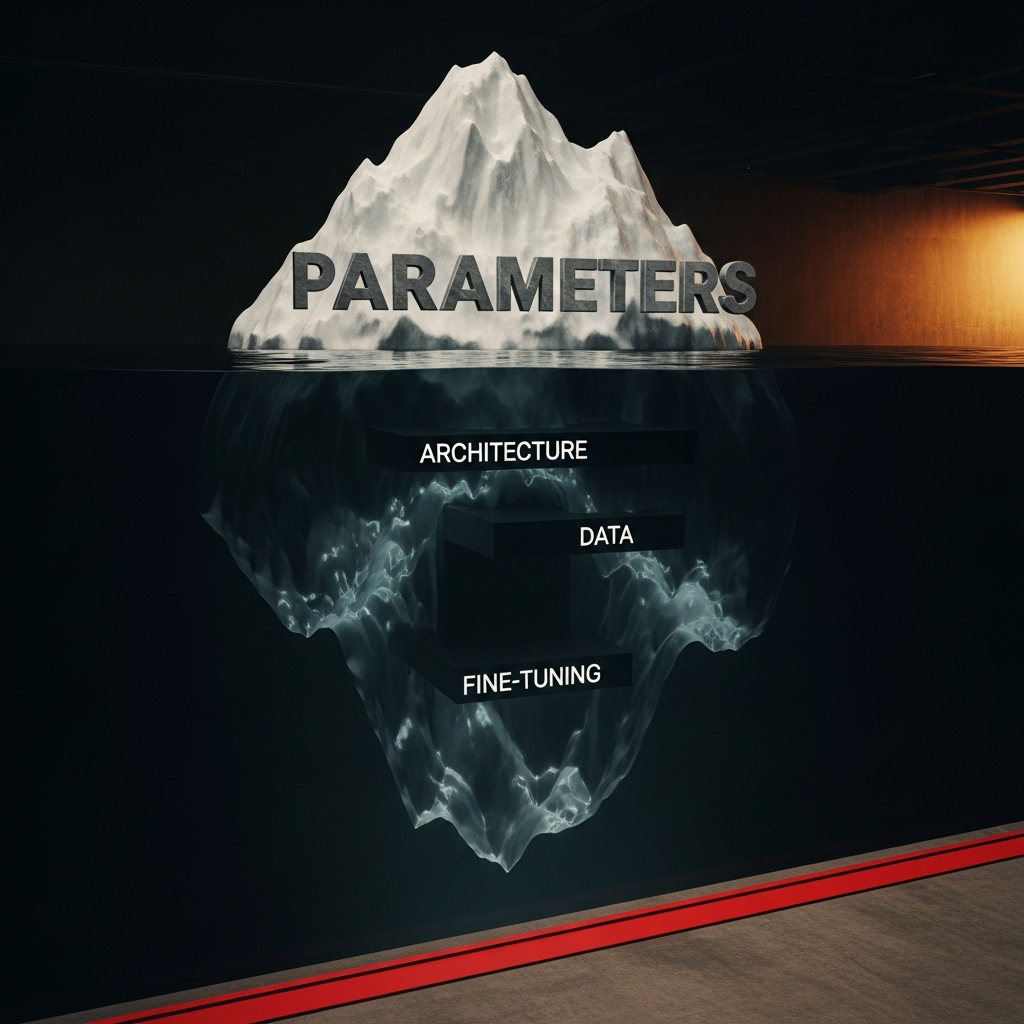
Bigger number, weaker decision metric
Most people asking how many parameters GPT has want a simple number. The honest answer: for current flagship GPT models, OpenAI does not publicly disclose it.
That frustrates buyers, operators, and technical teams because the market trained everyone to treat parameter count like horsepower. More parameters must mean a better model, right? Not anymore.
That was a useful shortcut in earlier model cycles. Today it breaks down fast. Performance now depends on far more than raw size: training data quality, architecture, multimodal design, reasoning methods, inference stack, context handling, and post-training alignment.
The real problem
Executives still use outdated metrics to evaluate AI vendors. Parameter count sounds concrete, so it gets repeated in boardrooms and procurement calls. But it can easily distract from the question that actually matters: Does this model produce reliable output for a real business workflow at an acceptable cost and speed?
A smaller or undisclosed model can outperform a much larger one for a specific use case. That’s especially true once latency, tool use, retrieval, workflow design, and guardrails enter the picture.
- Parameters tell you capacity, not business value
- Benchmarks tell you more, but still not enough
- Workflow performance is what actually moves margin
A real use case
Say a $75M services company wants to automate first-pass contract review. The CFO asks the obvious question: “Which model is bigger?” Wrong filter.
The better evaluation looks like this:
- Accuracy: Does it catch redlines and risky clauses?
- Consistency: Does it behave the same across 500 documents?
- Speed: Can legal and finance turn agreements faster?
- Cost: What’s the cost per reviewed contract, not per million tokens?
- Control: Can it cite source text and stay inside policy?
In practice, the winning system usually isn’t “the biggest model.” It’s a well-designed stack: the right model, the right prompts, retrieval from internal documents, human review on edge cases, and automation around approvals.
What we actually know
Older GPT generations triggered endless speculation, with outside estimates ranging wildly. But estimates are not facts, and for the latest models they’re even less useful. Modern model performance can come from architecture choices and optimization tricks that parameter count alone won’t reveal.
That means leaders should stop treating undisclosed model size as a red flag by default. The better question is whether the vendor can prove business outcomes in your environment.
The takeaway
If you’re a CFO or business owner, stop asking “How many parameters does it have?” as your first question.
Ask this instead: What task does it automate, how accurate is it in our workflow, what controls are in place, and what is the ROI at scale?
Model size makes for good headlines. Operational performance is what makes payroll.
Número maior, métrica pior para decidir
A maioria das pessoas que pergunta quantos parâmetros o GPT tem quer um número simples. A resposta honesta: nos modelos GPT de ponta atuais, a OpenAI não divulga isso publicamente.
Isso frustra compradores, operadores e equipes técnicas porque o mercado acostumou todos a tratar contagem de parâmetros como potência de motor. Mais parâmetros significam modelo melhor, certo? Não mais.
Esse atalho foi útil nos ciclos anteriores de modelos. Hoje ele falha rápido. O desempenho agora depende de muito mais do que tamanho bruto: qualidade dos dados de treino, arquitetura, design multimodal, métodos de raciocínio, stack de inferência, gestão de contexto e alinhamento pós-treinamento.
O problema real
Executivos ainda usam métricas ultrapassadas para avaliar fornecedores de IA. Contagem de parâmetros parece concreta, então ela aparece em reuniões de diretoria e chamadas de compras. Mas isso pode facilmente distrair da questão que realmente importa: esse modelo gera resultados confiáveis para um fluxo real de negócio com custo e velocidade aceitáveis?
Um modelo menor ou com tamanho não divulgado pode superar um muito maior em um caso de uso específico. Isso é ainda mais verdade quando entram em jogo latência, uso de ferramentas, retrieval, desenho de workflow e guardrails.
- Parâmetros indicam capacidade, não valor de negócio
- Benchmarks dizem mais, mas ainda não bastam
- Desempenho no workflow é o que realmente move margem
Um caso real de uso
Imagine uma empresa de serviços com US$ 75 milhões em receita que quer automatizar a revisão inicial de contratos. O CFO faz a pergunta óbvia: “Qual modelo é maior?” Filtro errado.
A avaliação correta se parece mais com isto:
- Precisão: Ele detecta redlines e cláusulas de risco?
- Consistência: Ele se comporta da mesma forma em 500 documentos?
- Velocidade: Jurídico e financeiro conseguem fechar contratos mais rápido?
- Custo: Qual o custo por contrato revisado, e não por milhão de tokens?
- Controle: Ele cita o texto-fonte e respeita a política interna?
Na prática, o sistema vencedor normalmente não é “o maior modelo”. É uma stack bem desenhada: o modelo certo, os prompts certos, retrieval dos documentos internos, revisão humana nos casos críticos e automação em torno das aprovações.
O que realmente sabemos
As gerações anteriores do GPT geraram especulações sem fim, com estimativas externas variando muito. Mas estimativa não é fato, e para os modelos mais recentes isso é ainda menos útil. O desempenho moderno pode vir de escolhas de arquitetura e otimizações que a contagem de parâmetros sozinha não revela.
Isso significa que líderes devem parar de tratar tamanho não divulgado como sinal vermelho por padrão. A melhor pergunta é se o fornecedor consegue provar resultado de negócio no seu ambiente.
Conclusão prática
Se você é CFO ou dono de empresa, pare de começar com “Quantos parâmetros ele tem?”
Pergunte isto no lugar: Que tarefa ele automatiza, qual a precisão no nosso workflow, quais controles existem e qual é o ROI em escala?
Tamanho de modelo rende manchete. Desempenho operacional é o que paga a folha.